Drawn Writings
DOI:
https://doi.org/10.26375/disegno.18.2026.4Abstract
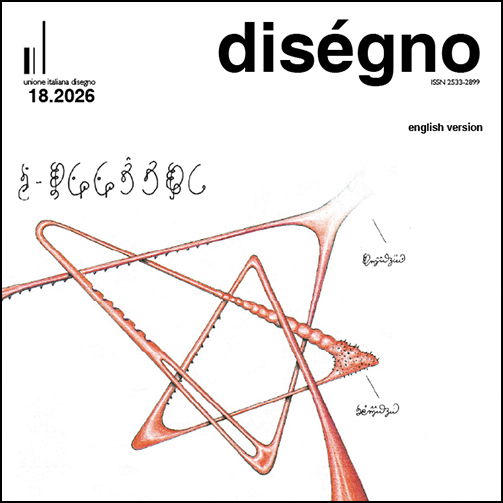
Luigi Serafini’s (1949) passion for nature has its roots in his childhood, when, in Pedaso, in the Marche region, he spent seemingly endless summer days in the enchanted park surrounding his relatives’ house, reached from Rome by car along the Via Salaria with his family. It was within this botanical and zoological enclave, situated not far from the river Aso, descending from the mythical Sibillini Mountains (though perhaps, as Serafini himself maintains, possessing a karstic source near Mount Aso in Japan), that the young Luigi began to draw plants and barnyard animals, perhaps sketching the first iconograms of that fantastic bestiary and herbarium which would later become the Codex Seraphinianus [Serafini 1981]. Symmetrically aligned with the longitudinal axis of the Apennines, as though within the mirror-world of Alice, the passion of Serafini for the classical world –nurtured by his father’s love of antiquities– had the opportunity to develop in the Eternal City, where he was allowed to freely wander among the Fori Imperiali, in a world equally resonant with mythological echoes, composed of arches, columns, brick walls, and precious marble claddings. (read more)
References
Cook, P. (1970). Architettura: azione e progetto. Roma: Calderini.
De Rosa, A. (2016). Disegni di architettura. In A. Ferlenga, M. Biraghi (a cura di). Comunità Italia. Architettura / Città / Paesaggio 1945-2000, pp. 224-227. Cinisello Balsamo: SilvanaEditoriale.
De Rosa, A. (a cura di). (forthcoming). Case o(a)ntologiche di Luigi Serafini. Conegliano: Anterem edizioni.
De Rosa, A., Calandriello, A. (2025). Un’Eterna Ghirlanda Brillante: architettura e design nell’opera di Luigi Serafini e nella sua casa ontologica. In A. Cortellessa, D. Isaia, P. Nocita (a cura di). Il sogno di Luigi Serafini, pp. 311-321. Milano: SilvanaEditoriale.
Fitoussi, B. (1998). Memphis. London: Thames & Hudson.
Merlino, M.M. (2008). E venne Valle Giulia. Roma: Settimo Sigillo.
Mezzetti, C. (a cura di). (2003). Il disegno dell’architettura italiana nel XX secolo. Roma: Edizioni Kappa.
Serafini, L. (1981). Codex Seraphinianus. Parma: Franco Maria Ricci.
Smith, K. (1997). Frank Lloyd Wright’s Taliesin and Taliesin West. New York: Harry N. Abrams.
Soleri, P. (1970). Arcology: City in the Image of Man. Cambridge: The MIT Press.
Villani, G. (2010). Domus Seraphiniana. In Interni, No. 600, pp. 22-29.
Villani, G., Taylor, J., Saint Pierre, L. (2023). Domus Seraphiniana. In FMR, No. 6, pp. 23-48.
Wilson, M., Sarda, M. (1999). Arcosanti Archetype: The Rebirth of Cities by Renaissance Thinker Paolo Soleri. New York: Freedom Editions.
Wolfler Calvo, M. (2007). Archigram/Metabolism. L’utopia negli anni Sessanta. Napoli: CLEAN.
Zevi, B. (1945). Verso un’architettura organica. Torino: Einaudi.
Downloads
Published
How to Cite
Issue
Section
License
Copyright (c) 2026 diségno

This work is licensed under a Creative Commons Attribution 4.0 International License.